17 methods explained step by step, from the simplest to the most advanced. Filter by pet or by level to find the one that suits you.
Pet:
Level:
List of methods
BeginnerAll species
⭐ Positive reinforcement
The core principle: a behaviour followed by something pleasant (a treat, play, a stroke) is more likely to happen again. It is the basis of almost every other method.
How to use it
Pick a reward your pet truly loves (not necessarily its everyday kibble).
Reward within 1 to 2 seconds of the right behaviour.
Keep sessions short (3 to 5 min) in a quiet place.
Increase difficulty gradually: distance, duration, then distractions.
Once learnt, space out food rewards and vary them (play, praise).
BeginnerAll species
🔘 Clicker training
The click is a “marker”: it tells your pet the precise moment it did the right thing, and a reward follows. Used with dolphins, horses, dogs, cats and even fish.
How to use it
Charge the clicker: click → treat, 10 to 15 times, without asking for anything.
Check: when you click, your pet turns its head towards you expecting a reward.
Click only at the exact moment of the right behaviour, then reward.
One click = always one reward, even if you clicked too early.
Add a verbal cue only once the behaviour is reliable.
Tip: a short, consistent word (“Yes!”, “Good!”) can replace the clicker.
BeginnerDog · Cat · Rabbit
🍖 Luring
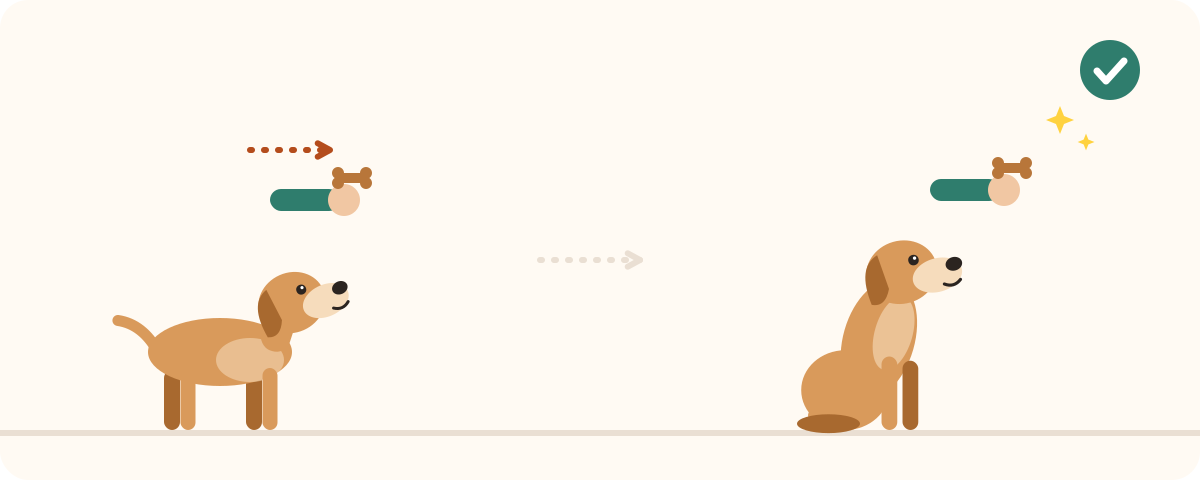
The treat guides the head up, the bottom goes down… and there's the sit!
You guide your pet with a treat held near its nose to bring it into a position. Very fast for teaching “sit”, “down” or “spin”.
Example: teaching “sit”
Treat in front of the nose, slowly raise your hand above its head.
The head goes up, the bottom goes down: mark and reward as soon as it touches the floor.
After 5 successes, make the same gesture without a treat in that hand, and reward with the other hand.
The gesture becomes a hand signal; then add the word “sit”.
⚠️ Fade the lure quickly, or your pet will only respond when it sees food.
BeginnerAll species
📸 Capturing
You wait for your pet to offer the behaviour spontaneously (lying down, stretching, settling on a mat) and reward it at that moment. Perfect for natural, calm behaviours.
How to use it
Keep treats (or a clicker) on you all day.
As soon as the behaviour happens, mark and reward.
When your pet starts offering it on purpose to earn a reward, add a cue word.
Ideal for: settling on a mat, “bow” (the stretch), yawning, a cat sitting.
IntermediateAll species
🧩 Shaping
You break a complex behaviour into small steps and reward each approximation that gets closer to the final result. It develops your pet's problem-solving and creativity.
Example: “go to your bed”
Reward a simple glance towards the bed.
Then a step towards it, then one paw in it.
Then all four paws, then sitting, then lying down in it.
Only move to the next step when the current one succeeds 80% of the time.
Works very well with a clicker. If your pet gets stuck, go back a step.
BeginnerAll species
🎯 Targeting
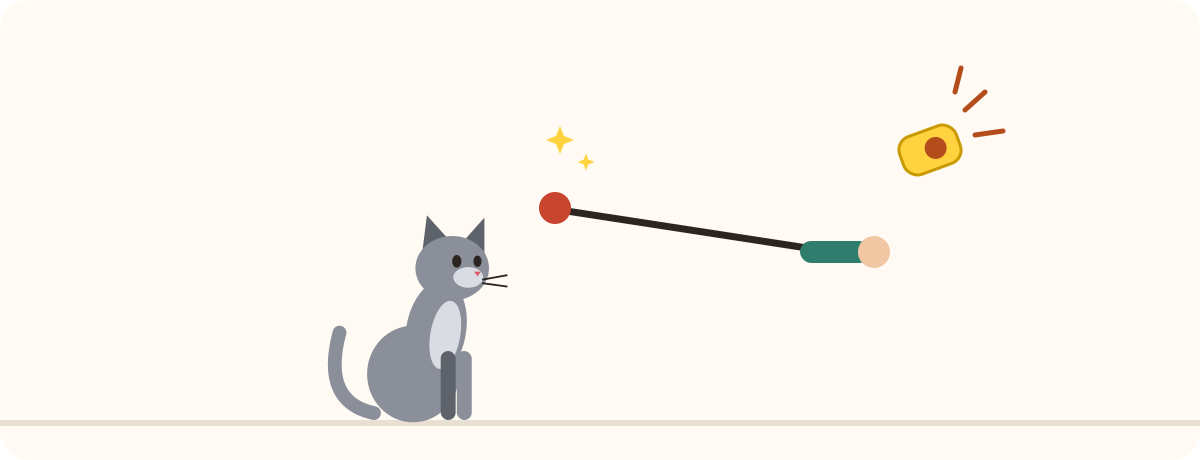
The click marks the exact moment the pet touches the target; the treat follows.
Your pet learns to touch a target (your hand, a stick, a lid) with its nose, paw or beak. Once learnt, you can guide it anywhere: onto the scales, into the carrier, onto a perch.
How to use it
Hold the target a few centimetres from the nose or beak.
As soon as it touches it (even out of curiosity): click + reward.
Gradually move the target further away, then move it so your pet follows.
Use it for recall, going into the carrier or agility tricks.
IntermediateAll species
🧘 Desensitisation & counter-conditioning
The reference method for fears and phobias. You expose your pet to the trigger at such a low intensity that it stays calm, and pair it with something very pleasant.
Example: fear of thunderstorms or fireworks
Play a thunderstorm recording at a barely audible volume.
While the sound plays: treats or play. Sound off: nothing.
Raise the volume very slightly over the days, only if your pet stays relaxed.
At the slightest sign of stress (ears back, panting, running away), lower the volume.
Also works for the car, the crate, nail clippers, the vacuum cleaner, other animals…
BeginnerAll species
🚧 Managing the environment
Preventing the unwanted behaviour from happening (and therefore from being rewarded) while your pet learns the right one. It isn't training in itself, but no method works without it.
Practical examples
A baby gate so the puppy can't go upstairs.
A closed bin rather than scolding the dog who knocks it over.
A scratching post placed where the cat scratches the sofa.
Protected cables for the rabbit, a long line for the dog who doesn't come back yet.
BeginnerDog · Cat · Rabbit
🤝 Socialisation
Positively introducing a young animal to the world during its sensitive period (around 3 to 12-14 weeks for puppies, 2 to 7-9 weeks for kittens). It prevents many adult fears.
The socialisation checklist
Different people: children, hats, beards, wheelchairs.
Golden rule: always at your pet's pace, with rewards, never forced.
IntermediateAll species
🩺 Cooperative care
Teaching your pet to take part willingly in care (nails, brushing, drops, check-ups) using a “consent signal”: if it leaves the position, you stop.
How to use it
Teach a start position: chin resting in your hand or on a cushion.
While the chin stays down, briefly touch a paw, then reward.
If it lifts its head, you stop: it learns it is in control, and accepts more.
Progress: touch → show the clippers → trim a single nail.
IntermediateDog · Cat
🔁 The Premack principle
Using something your pet wants to do as the reward for a less appealing behaviour: “first you look at me, then you can go and sniff”.
Examples
Calm sit → the door opens for the walk.
Successful recall → “go play!”, back to its friends.
Loose lead → we move towards the smell it is interested in.
Very powerful, because the reward is exactly what your pet wants at that moment.
BeginnerDog · Cat
🎟️ Learn to Earn
Everyday resources (meals, walks, play, attention) are earned with a polite behaviour, often a simple sit or eye contact. It gives a clear, reassuring framework, without conflict.
How to use it
List what your pet wants during the day.
For each resource, ask for a calm behaviour it already knows.
Stay kind: this is about manners, not dominance.
You can also serve part of the daily ration in food puzzles.
AdvancedDog
👀 Look At That (LAT)
From Leslie McDevitt's “Control Unleashed” programme. The dog is rewarded for calmly looking at what worries it (a dog, a bike), then turning back to you. Excellent for on-lead reactivity.
How to use it
Stay far enough from the trigger for your dog to remain calm.
As soon as it looks at it: marker (“Yes”) then treat.
It learns to look, then automatically turn back to you.
Reduce the distance very gradually, over several weeks.
AdvancedDog
🌿 BAT (Behavior Adjustment Training)
Grisha Stewart's method for fearful or reactive dogs. The dog explores freely on a long lead and approaches at its own pace; it learns that calmly moving away is a solution.
Key principles
Work below the reaction threshold, at a good distance.
Let the dog choose its movements (long, loose lead).
The “reward” is functional: moving away, sniffing, exploring.
Ideally guided by a trainer trained in BAT.
AdvancedDog
🪞 Imitation (“Do As I Do”)
Developed by Claudia Fugazza: the dog learns to reproduce an action you have just performed (touching an object, turning around) on the cue “Do it!”.
How to use it
First teach 3 simple actions with another method (e.g. spin, touch a box).
Do the action yourself, say “Do it!”, ask for the same action, reward.
Little by little, the dog understands the rule and can imitate new actions.
IntermediateBird
🦜 The model/rival method
Developed by Irene Pepperberg with Alex, the famous parrot. Two people demonstrate the expected behaviour (e.g. naming an object) to each other in front of the bird, which learns by watching and then “competing” with the model.
How to use it
One person asks a question (“What colour?”), the other answers and receives the object.
Swap roles so the bird sees both sides.
Then ask the bird the question and reward any attempt.
IntermediateAll species
🔇 Ignore + reward the alternative
No longer rewarding an attention-seeking behaviour (jumping up, meowing, screeching) while actively rewarding an incompatible one (sitting, four paws on the floor, being quiet).
How to use it
Identify what keeps the behaviour going (often your attention).
Remove it consistently: the whole family must do the same.
Generously reward the chosen alternative.
Expect a temporary worsening (“extinction burst”): hold on.
⚠️ Never ignore a behaviour linked to fear, pain or an unmet need.
Avoid
❌ Aversive (“traditional”) methods
Hitting, shouting, lead jerks, choke, prong or shock collars, the “alpha roll”… These rely on fear and pain. Several scientific studies have shown that they increase stress, fear and the risk of bites, without being more effective than rewards. Shock collars are banned in several European countries, and many veterinary associations advise against them.
The “dominance” theory (having to be the “pack leader”) has been abandoned by behaviour specialists.
Our position: we do not recommend or sell any aversive tool. If a behaviour is beyond you, see a veterinary behaviourist or a trainer who uses positive methods.