🍼 A puppy's first days
Give it a quiet corner with a bed or an open crate.
Start socialisation straight away, gently.
Respect its sleep: a puppy sleeps 16 to 20 hours a day.
Training sessions of 2 to 3 minutes, several times a day.
Sign up for puppy classes that use positive methods.
👉 Read: Welcoming a puppy: the complete checklist (and what to skip)
🚽 House training
Take it out on waking, after every meal, every play session and every 2 hours.
Always to the same spot; wait calmly.
Praise and reward while it goes or right after, on the spot.
An accident? Clean without scolding using an enzymatic cleaner (bleach attracts urine).
👉 Full article
👉 Read: House training your puppy: the method that works
🪑 Sit, down, stay
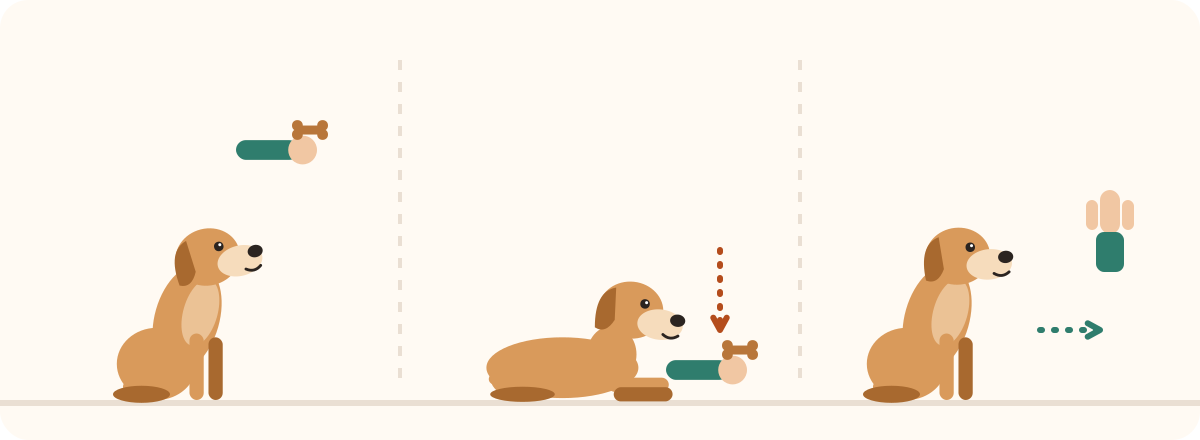
1. Sit: treat above the head · 2. Down: treat towards the floor · 3. Stay: hand raised, one step back. Sit: by luring , treat above the head.
Down: from the sit, lower the treat between its front paws, then towards the floor.
Stay: work on the “3 Ds” separately: duration (1 s, then 3, then 10), distance (one step back), then distractions . Never increase them at the same time.
👉 Read: Teaching your dog "sit", "down" and "stay" · Which training treats for your dog? The comparison · Which treat pouch to choose? The comparison
📣 Recall
Choose a dedicated word (“Here!”) never used for anything unpleasant.
At home: say the word, reward with a “jackpot” (several great treats).
Outside, use a for safety.
Don't only call it to end the walk: call, reward, release.
As a back-up: a , which carries further than your voice and always sounds the same. Full article .
👉 Read: How to teach your dog a reliable recall in 7 steps
🦮 Loose-lead walking
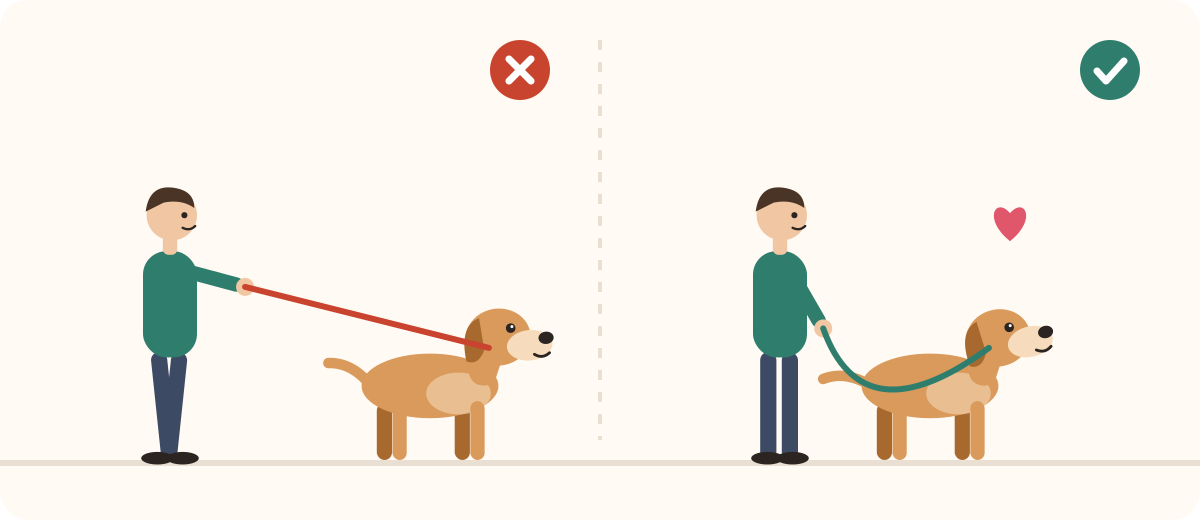
Left: the lead is tight, so you stop. Right: the lead is loose, so you walk on and reward.
Tight lead = we stop. Loose lead = we move on (Premack ).Reward often when it is at your side.
Change direction when it pulls: it learns to keep an eye on where you're going.
Prefer a Y-shaped harness, which doesn't press on the throat, to a collar.
👉 Full article
👉 Read: Dog pulling on the lead: how to make it stop · Which dog harness should you choose? Our comparison
🏠 Learning to be left alone
Start by leaving for a few seconds into another room.
Build up the duration gradually, without big goodbyes or big hellos.
Give it something to do: a frozen stuffed toy, a snuffle mat.
A camera lets you check it stays relaxed.
Destruction, howling or house-soiling as soon as you leave can signal separation anxiety: talk to your vet.
👉 Read: Dog barking when left alone: understand it and help · Best quiet dog toys for renters and dogs left alone: our comparison · Which camera to watch your dog or cat? Our comparison
🔊 Barking
First find the cause: alerting, boredom, fear, attention-seeking. Then:
Alerting: say thanks (“thank you!”), call it to you, reward the quiet.Boredom: more physical and mental exercise (sniffing, food puzzles).Fear: desensitisation .Attention: ignore + reward calm .
Avoid anti-bark collars (shock, spray): they treat the symptom and increase stress.
👉 Read: Dog barking when left alone: understand it and help
🦷 Puppy biting
It's normal: puppies explore with their mouths and are teething.
As soon as it bites a hand, stop the game for a few seconds, then offer a toy.
Always have permitted chew toys available.
A tired puppy bites more: think nap time!
👉 Full article
👉 Read: My puppy bites: what should I do?