Which scratching post should you choose for your cat? Our comparison
Plenty of scratching posts end up ignored in a corner while the cat carries on attacking the sofa. The problem rarely lies with the cat: it's usually the post that doesn't suit it. Here's how to choose one your cat will really use.
The 4 criteria that really matter
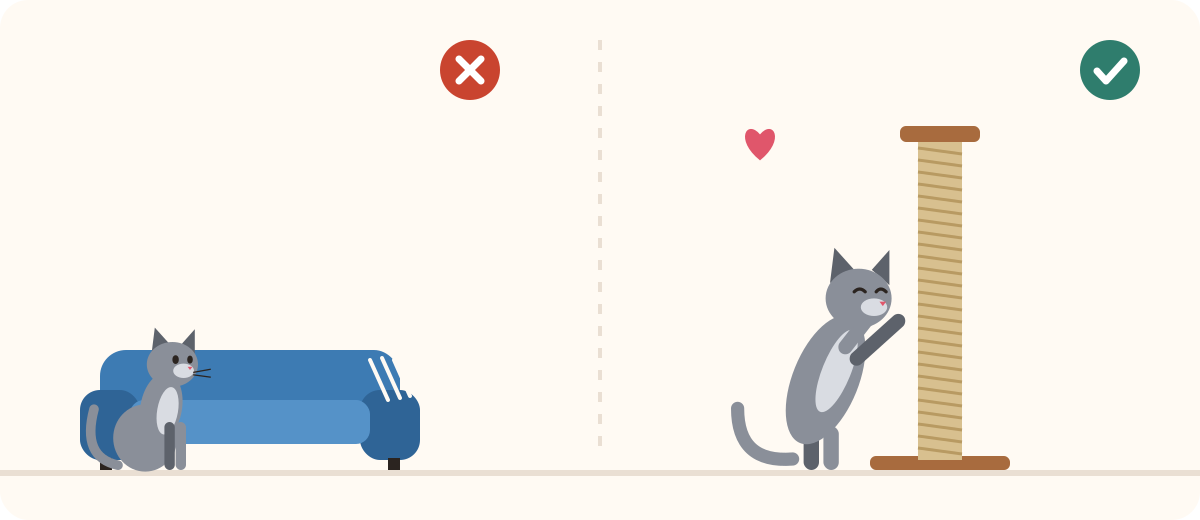
- Stability. A post that wobbles or tips over scares the cat, who won't come back. This is the number one criterion.
- Height. Your cat must be able to stretch out fully, front legs extended: allow at least 70 to 80 cm for an adult cat.
- Material. Woven sisal (rope or fabric) is the favourite. Cardboard is very popular for scratching flat. Carpet is less advisable: it looks just like your rugs.
- Direction. Some cats scratch vertically (sofa, doors), others horizontally (rugs, doormats). Watch yours before you buy.
The 5 types of scratching post compared
| Type | Strengths | Limits | Best for |
|---|---|---|---|
| Sisal post | Compact, ideal for vertical stretching | Must be tall and heavy | Every cat's first scratching post |
| Cat tree | Scratching, climbing, sleeping, watching | Bulky, choose a stable one | Indoor cats, multi-cat homes |
| Cardboard scratcher | Cheap, very popular | Wears quickly, leaves crumbs | Cats that scratch flat |
| Sloped scratcher | Halfway between vertical and horizontal | Smaller, less stretching | Older cats, kittens |
| Wall or corner scratcher | Directly protects a sofa corner or wall | Needs fixing in place | Small spaces, one specific area to protect |
1. The sisal post: the first thing to buy
A simple post, as long as it's tall and weighted, covers most needs: scent marking, claw care and stretching. Put it right in front of the spot your cat is currently damaging.
Check the total height and the weight or size of the base: a wide base stops it tipping over.
2. The cat tree: the complete playground
For an indoor cat, a cat tree offers much more than a scratching post: height to watch from, hiding places to rest and a way to burn off energy. Choose thick posts, a wide base and, for tall trees, a wall fixing.
Go for thick sisal posts and a high platform big enough to stretch out on.
3. The cardboard scratcher: many cats' favourite
Placed on the floor, it's a huge hit with cats that scratch rugs. Cheap, it wears out but is easy to replace (many models have refills). It often doubles as a bed too.
Reversible models last twice as long.
4. The sloped scratcher: for older cats and kittens
Halfway between vertical and horizontal, it's easy to use for a cat with stiff joints or a kitten discovering scratching. It complements a post nicely.
5. The wall or corner scratcher: to protect one specific spot
Fixed to the wall or wrapped around a sofa corner, it covers exactly the area your cat has chosen. Handy in a small flat.
Ideal for protecting a sofa corner that's already been attacked.
How many scratching posts do you need?
At least one per cat, and ideally one near each important area: next to where your cat sleeps (cats scratch a lot when they wake up), near the entrance to the main room and in front of the targeted furniture. In a multi-cat home, add more to avoid tension.
Getting your cat to use the post
A new scratching post doesn't smell of your cat. To help it get adopted: rub a little catnip on it, run a feather wand over it, and reward every scratch. That's positive reinforcement. Meanwhile, temporarily cover the forbidden area (managing the environment).
Many cats react to it, but not all: yours may ignore it.
Read more: cat scratching the sofa: 6 solutions · the complete guide to training your cat · all our recommended gear.
Read next

Best Toys for Indoor Cats: Which to Choose?
Feather wands, puzzle feeders, tunnels or tracks: the toys that truly fulfil an indoor cat.
Cat litter price comparison: real cost per month and which to choose
Clumping, plant-based, silica or clay: pros, cons and how to switch litter without upsetting your cat.
Cat meowing at night: why it happens and how to sleep again
Hunger, boredom, age or heat: understand why your cat wakes you up, then adjust their day for peaceful nights.