Which dog harness should you choose? Our comparison
A good harness protects your dog's neck, makes walks more pleasant and helps with loose-lead training. But between Y-front, no-pull, H-shaped and “Norwegian” harnesses, it's hard to know where to start. Here's our comparison to help you choose.
Why a harness rather than a collar?
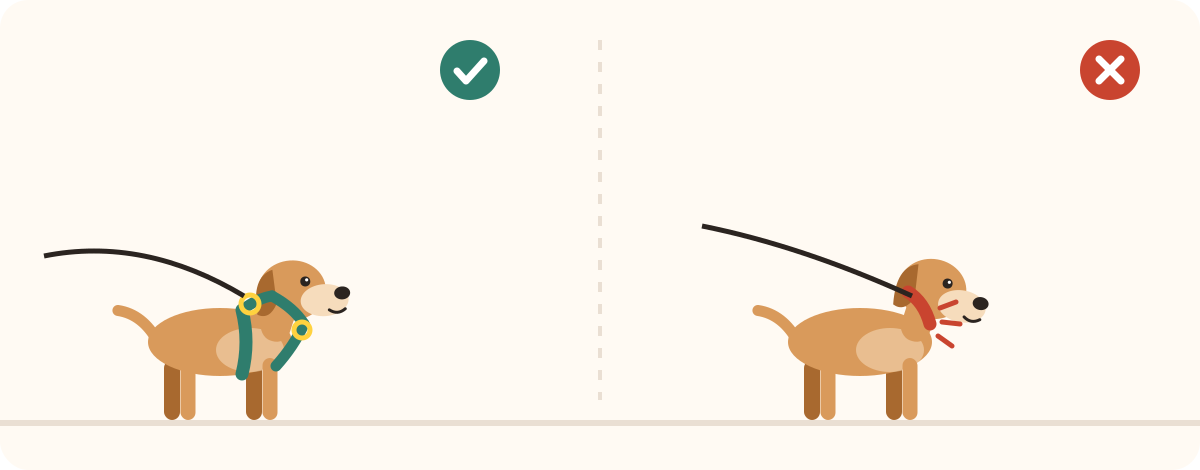
When a dog pulls on a collar, all the pressure goes on the throat and neck, a delicate area (windpipe, thyroid, neck vertebrae). A harness spreads that pressure across the chest. This matters most for dogs that still pull, small dogs, flat-faced breeds and dogs with breathing problems. A collar is still useful for carrying the ID tag.
The 5 types of harness compared
| Type | Strengths | Limits | Best for |
|---|---|---|---|
| Y-front | Free shoulders, natural movement, comfortable | Must fit well so it doesn't slip | Most dogs, every day |
| Y-front with two clips | Chest ring for training, back ring for walks | A little more expensive | Dogs that still pull, puppies |
| H-harness | Stable, hard to slip out of | Takes longer to put on | Nervous dogs that might back out to escape |
| Horizontal strap (“Norwegian”) | Very easy to put on | The strap can restrict shoulder movement | Short outings, dogs that don't pull |
| Car safety harness | Attaches to the vehicle's seat belt | Less suited to walking | Car journeys |
1. The Y-front harness: the best everyday choice
Seen from the front, its straps form a “Y” that runs between the front legs and clears the shoulders. Your dog keeps a natural stride, which makes it ideal for long walks, canicross or hiking.
Look for straps that adjust in at least 4 places and padding on the chest.
2. The two-clip harness: for learning not to pull
This is a Y-front harness with a second ring on the chest. With the lead clipped at the front, a dog that pulls is gently turned back towards you instead of moving forwards: a real help while you work on loose-lead walking, without any pain. The Ruffwear Front Range is a well-known model of this type; many other brands make an equivalent.
The most versatile: front clip for training, back clip afterwards.
A padded Y-front harness with two clips, often praised for its comfort.
Pair it with a 2 m lead with a clip at each end: you can attach it to both rings at once for gentle control.
Use it at 2 m, over the shoulder, or clipped to both the back and chest rings.
3. The H-harness: for escape artists
It has one strap around the neck and another behind the front legs, joined by a band along the back. Some models add a third strap around the belly, which makes them very hard to back out of: a real plus for nervous dogs, newly adopted dogs or rescues.
With an extra belly strap, for fearful dogs that back away when startled.
4. The horizontal-strap harness: handy, but not ideal
Very common, it goes on in seconds. But its horizontal strap sits across the front of the shoulders and can limit movement, especially if the dog pulls. Keep it for dogs that already walk nicely on the lead, or for short outings.
5. The car safety harness
In the car, a dog should be secured or travel in a crate. A harness that works with the seat belt stops your dog being thrown forward when you brake. Choose a model designed for this purpose rather than a walking harness clipped to the belt.
With a dedicated seat-belt attachment; check the manufacturer's information on testing.
How to choose the right size
- Measure the chest girth at its widest point, just behind the front legs.
- Measure the neck at its base, where a collar would sit.
- Compare with the manufacturer's size guide (it varies from brand to brand); if you're between two sizes, choose the one with more room to adjust.
- Once it's on, you should be able to slide two fingers under each strap, and the harness mustn't rub under the armpits.
Getting your dog used to the harness
Some dogs don't like having something put over their head. Go gently with positive reinforcement: show the harness, reward; let your dog put its head through the opening by holding a treat on the other side; close one buckle, reward. A few sessions are often enough. This is the principle of cooperative care.
Read more: dog pulling on the lead: the method · teach a reliable recall in 7 steps · all our recommended gear.
Read next
Clicker Training for Beginners: Dogs and Cats
Charging the clicker, first exercises and mistakes to avoid: the step-by-step method for dogs and cats.
Best Puzzle Toys for Dogs: Our Comparison
Puzzles, snuffle mats, dispensers or hide-and-seek toys: which brain game suits your dog.
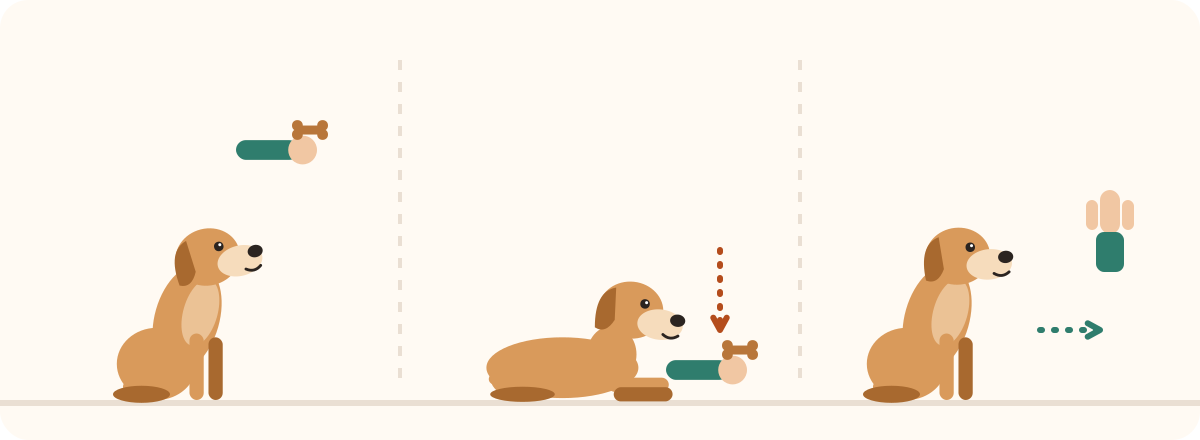
Teaching your dog "sit", "down" and "stay"
Luring for sit and down, then the "3 Ds" for a solid stay: the gentle method, step by step.