House training your puppy: the method that works
Puddles in the living room, rugs to wash, night-time wake-ups… House training is often the first challenge with a puppy. The good news: with routine and patience, most puppies are house-trained within a few weeks to a few months.
Why your puppy isn't house-trained yet
A young puppy doesn't yet have good bladder control. It needs to go often, and it doesn't yet know that the house isn't the right place: at the breeder's, it often went wherever it happened to be. So it never does it “on purpose” or “out of spite”. Your job is to show it where to go, at the right time, and to make that place very rewarding.
1. Go out at the right times
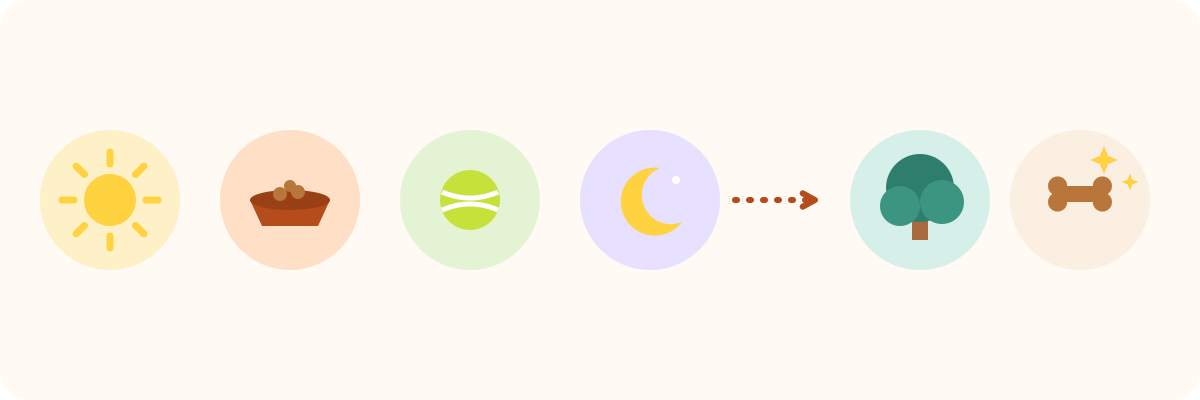
The secret is to anticipate: take your puppy out before it has a chance to get it wrong. The key moments:
- on waking, in the morning and after every nap;
- after every meal (within 15 to 30 minutes);
- after a play session or excitement;
- before bed in the evening;
- and, on top of that, at regular intervals during the day (every 1 to 2 hours at first).
Watch for the signs too: sniffing the floor while circling, heading for the door, suddenly wandering off. If so, go out immediately.
2. Always the same spot
Always take your puppy to the same patch of grass, on the lead, and wait calmly without playing. The smell of its previous visits will encourage it to go there again. You can say a gentle, consistent word (“busy”) while it goes: over time, it will link it to the action.
3. Reward at the right moment
This is the heart of the method, based on positive reinforcement: as soon as it has finished, on the spot, praise enthusiastically and give a treat. If you wait until you're back inside, it won't make the connection. Keep rewards on you so you never miss that moment.
Small and very tasty, keep them in your pocket on every outing to reward within a second.
4. Supervise or limit the space
A puppy wandering alone around the whole house will inevitably have accidents out of sight. When you can't supervise it, limit its space to one room or a pen with its bed: dogs generally avoid soiling where they sleep. That's managing the environment.
To give it a safe space when you can't supervise it, without shutting it in a small cage.
If you use a crate, it must remain a pleasant place and never a punishment, and a puppy shouldn't stay shut in it for hours.
5. Clean up accidents properly
There will be accidents; that's normal. Don't scold: your puppy wouldn't understand and might learn to hide when it goes. Simply clean with an enzymatic cleaner, which breaks down odour molecules. Avoid bleach and ammonia-based products: their smell resembles urine and can encourage it to go in the same spot again.
It truly removes the smell for your puppy's nose, not just for yours.
If you catch it in the act, interrupt calmly (without shouting), take it outside and reward it if it finishes in the right place.
6. What about at night?
A young puppy may need to go out once during the night at first. Put its bed near your bedroom so you hear it stirring, take it out briefly, without play or long cuddles, then settle it back down. As it grows, it will hold on longer and longer.
What about puppy pads?
They can help out (a flat several floors up, a puppy not yet vaccinated), but they teach the puppy that it's allowed to go indoors. If you use them, place them near the door and gradually move them outside.
Go further: a puppy's first days · my puppy bites: what should I do? · socialisation.
Read next
Welcoming a puppy: the complete checklist (and what to skip)
The essentials from day one, what can wait and the pointless purchases: the complete checklist.
My puppy bites: what should I do?
Teaching bite inhibition, offering the right toys and respecting nap time.
Clicker Training for Beginners: Dogs and Cats
Charging the clicker, first exercises and mistakes to avoid: the step-by-step method for dogs and cats.